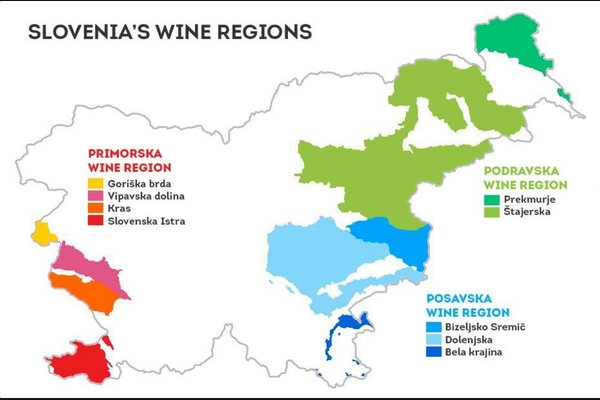
From the sun-baked hills of Goriška Brda to the cool terraced vineyards of Štajerska, Slovenia packs an extraordinary range of terroirs into a country the size of a small Italian province. Three macro-regions, nine distinct districts — each shaped by its own soil, wind and winemaking tradition. Here they are, one by one.
They call it the Slovenian Tuscany — and once you see the terraced hills rolling towards the Italian border, you understand why. But Brda is its own thing entirely. The legendary opoka soil — ancient flysch compressed into alternating layers of marl and sandstone — gives wines here an electrifying minerality that no other place in the world can replicate. Between the Julian Alps to the north and the warm Adriatic breath from the south, Rebula ripens slowly on impossibly steep slopes, harvested by hand, and makes wines of crystalline precision and depth. One producer for every eight inhabitants: this is wine country in the most fundamental sense.
The Vipava Valley is shaped by wind. The Burja — a fierce northeast gale that can tear through the valley at 120 km/h ten times a year — keeps disease away, concentrates flavours, and defines the character of every bottle made here. Vines grow low to the ground, roots drilling fifteen metres deep into flysch soils to find water and minerals. The result is wines of surprising purity: white blends of Zelen, Pinela, Malvasia and Rebula that carry the freshness of the Alps and the warmth of the Adriatic simultaneously. This is also where Slovenia's most exciting winemaking experiments happen — an irreverent, forward-thinking valley that has nothing to prove.
The word karst — used worldwide to describe limestone landscapes — was coined here. On this rugged plateau above the Gulf of Trieste, white limestone bedrock is blanketed with a layer of iron-rich red soil the colour of dried blood: terra rossa. From it comes Teran, one of Slovenia's most ancient and protected wines — a deep ruby-almost-black red with bracingly high acidity, wild berry aromas and an iron-mineral grip that feels like drinking the land itself. Sold in Viennese pharmacies in the 16th century as a remedy for anaemia. Some things are better explained through taste than history.
Slovenia's warmest vineyards look out over the Adriatic. Three winds take turns shaping the growing season: the cold Burja, the warm Jugo, and the salt-scented Maestral off the sea. Here Refošk is king — a grape of vivid cherry colour, firm acidity and a character that shifts from rich and velvety on the coast to darker and wilder just a few kilometres inland. And then there is Malvasia — queen of the Istrian whites — arriving with acacia blossom, citrus and bitter almond, a wine that smells of Mediterranean summers and lingers long on the finish. Wine traditions here trace back to Roman times, when Livia, wife of Augustus, reportedly had roads built into Istria just to secure her supply.
Slovenia's largest wine district — nearly 40% of all national production — sits where the cool Pohorje Hills meet the warm breath of the Pannonian Plain. Steep terraced vineyards at 350–600 metres produce whites of remarkable aromatic precision and natural freshness. Sauvignon Blanc here develops a lively, herbaceous character; Šipon (Furmint) achieves genuine complexity; Rhine Riesling and Muscat offer some of the most expressive examples in Central Europe. And here stands the Stara trta in Maribor — a single grapevine over 450 years old, certified by Guinness as the world's oldest. Still producing grapes. Still making wine.
Tucked into Slovenia's northeastern corner, pressed between the Mura River and the Hungarian border, Prekmurje is a land apart — flat, quiet, unhurried, with volcanic soils and a deeply continental climate of hot summers and cold winters. Hungarian winemaking traditions bleed across the border; so does a taste for Welschriesling, Chardonnay, and Blaufränkisch (Modra Frankinja) with genuine depth and structure. Small production, low profile, singular character. This is where you find wines that taste like a place nobody has thought to visit yet.
The birthplace of Cviček — Slovenia's most characterful traditional wine and one of the most unusual in all of Europe. A pale ruby blend of red and white grapes, light in body, high in acidity, low in alcohol, and totally honest about what it is: a wine made for food and company rather than for impressing anyone. The gently rolling hills of Dolenjska, cooled by alpine influences and warmed by continental summers, produce 7,500 winemakers who still make wine for the pleasure of it. Cviček has PGI protection — because you simply cannot make it anywhere else.
Between the Sava and Sotla rivers lies a landscape unlike anywhere else in Slovenia — vineyards protected from harsh northern winds by low mountains, and beneath the ground an extraordinary network of hand-dug caves called repnice, carved into soft sandstone to store wine at a perfect natural temperature. The Blaufränkisch from this district has come a long way from its humble origins: structured, spicy, and quietly impressive. The district is also building a reputation for sparkling wines made in the traditional method — cool nights and a long growing season doing what they do best.
Slovenia's smallest wine district sits in the far south, where the Gorjanci Hills give way to warm limestone plains and the first hints of Adriatic warmth reach continental Posavje. The temperature swings between day and night are dramatic — which means one thing for wine: extraordinary aromatic intensity and freshness preserved in every bottle. Bela Krajina made the first ice wine and the first rosé in Slovenia. Its Blaufränkisch and Yellow Muscat are the district's signatures; its dessert wines are among the country's most celebrated. Small in size, large in ambition.